Patients United ask MND Association & Mirocals Consortium to consider terminating ILTOO contract
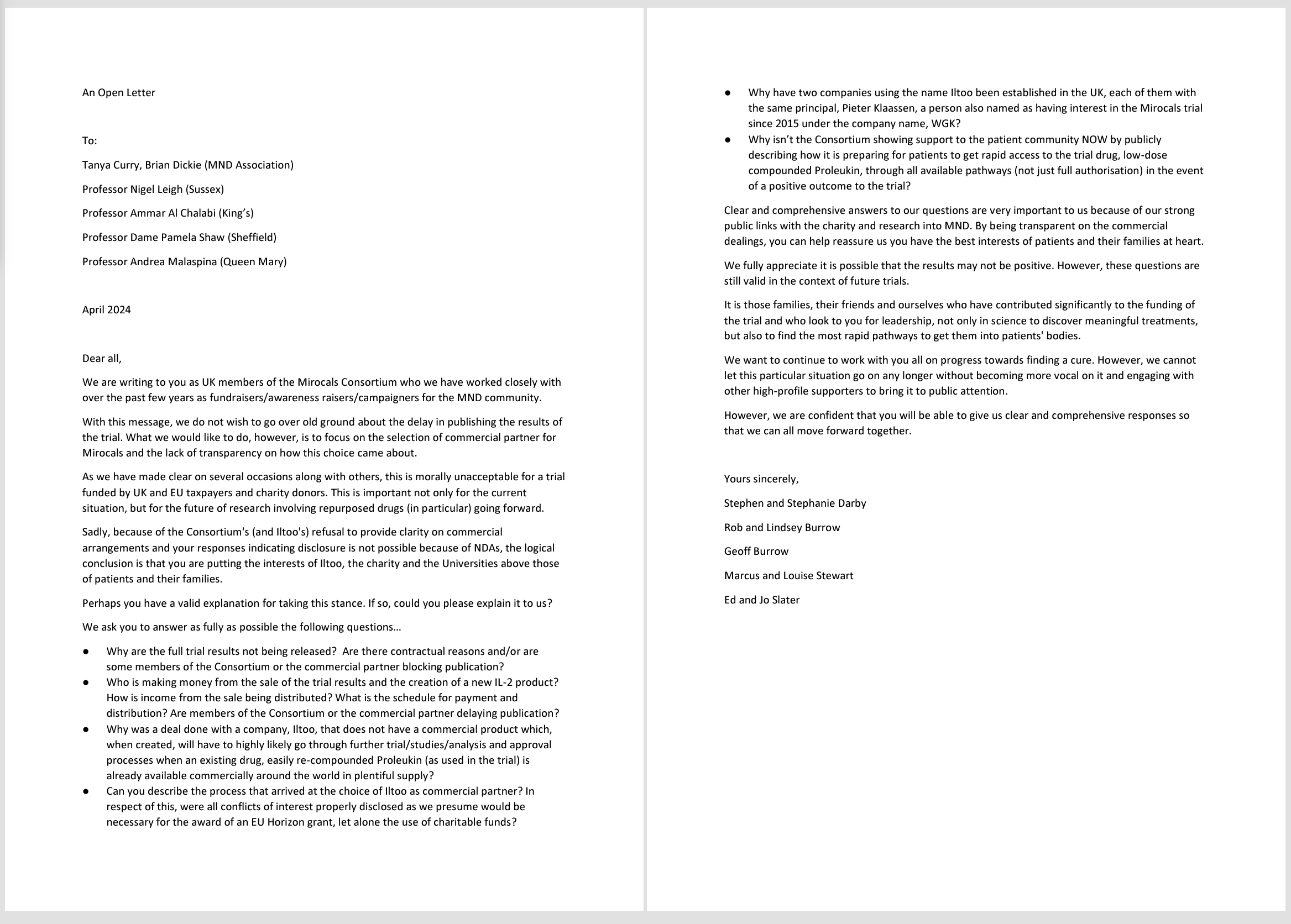
Last Friday, May 3rd, we asked the MND Association and professors involved with the Mirocals trial:
- if they had responded to the high profile patients’ letter dated April 22 and if they would make their response public.
- to consider terminating the Mirocals Consortium contract with ILTOO
Our message has been acknowledged, but as yet we have no substantive response. Neither, as far as we know, do the high profile patients.
Our message, with a couple of minor amendments, is reproduced below. Please continue to support our efforts to get transparency for a publicly funded trial via social media or direct communication with the Mirocals members. Thank you for your amazing efforts so far.
A similar letter was also sent to some of the involved scientists.
Dear MND Association,
We are sure you will have seen the open letter on Mirocals from high profile patients and their families by now. As it was sent on April 22, we were wondering if you have responded jointly or separately and if you would make your response public in the same vein?
We do understand the scientists’ goal has been to help everyone living with MND and greatly appreciate the hard work that has gone into the project over the past 10 years and the first-class science. We do not suggest any impropriety, but we believe commercial mistakes may have been made, hence the questions.
Without comprehensive answers, we are led to the conclusion that the Consortium puts commercial considerations above the best interests of patients. This is because of…
- The ongoing delay. MRC funded studies require that results “must be published without unreasonable delay following conclusion of the study (generally within 12 months completion).” In addition, we understand that assistance from the charities to help with analysis was turned down.
- The knowledge that progress is in the hands of Iltoo
- The near certainty that Iltoo cannot deliver its new therapy as quickly and at sufficient scale for demand as would be the case with low-dose Proleukin.
- The continuing focus on the full regulation for a new product when alternative access pathways are available n.b. we do not accept the argument we have heard that the (scientific) task ends with the science. To us,(the scientists) are neurologists, as well as neuroscientists.
You may have answers to these questions based on science, knowledge of regulation of trials and access pathways to new treatments. Please let us have them.
To us, it is absolutely vital that you now remedy any mistakes. We now ask you to consider, jointly with your Consortium colleagues or separately, terminating the contract and seeking a new deal with a company better equipped to deliver an appropriate therapy (most likely low-dose Proleukin) in the event of a positive outcome to the trial.
We look forward to hearing from you.
With best wishes. Patients United 2 End MND

 We are United2EndMND - Changing the conversation