

Our response to 12th August MND Association Mirocals statement
Where are the results?
Why fixation on Iltoo product when trial drug already exists?
Do commercial interests come before patients’ needs?
While the MND Association’s (MNDA) recently found energy in pursuing pharma ILTOO for answers in its latest Mirocals update is welcome we must continue to press our leading charity to answer crucial outstanding questions on the trial.
Summary
This latest statement confirms our views* that the MNDA position on Mirocals is likely, in the event of a positive outcome, to delay the fastest routes to access the trial drug. This is underlined by the confirmation that the Managed Access Programme (MAP) is in fact NOT available to any patients other than ex-trial participants.
*With only a few answers to questions we have asked for over 18 months, we can see no other conclusions. However, we invite the MNDA to explain why we may be misguided. E.g. Is ILT-101 in some way a “better” drug? Can it be delivered faster than the trial drug, low dose Proleukin?
MNDA’s continuing emphasis on ILT-101 and the FULLY REGULATED route for THAT form of IL-2 suggests it does NOT have everything in place to fight for access to the quickest possible pathways to low-dose Interleukin 2, in whatever form, via the NHS Specials and NHS Medicines Repurposing routes.
Together with our latest efforts, in vain, to get Freedom of Information (FOI) responses on the contractual arrangements for the trial, the statement adds to suspicions that commercial interests are stalling the publication of results.
Here is our latest FOI response from Sussex University (one of the public institutions we sent the FOI request to) basically saying ‘commercials trump your request!’? For the full response please click on the image.
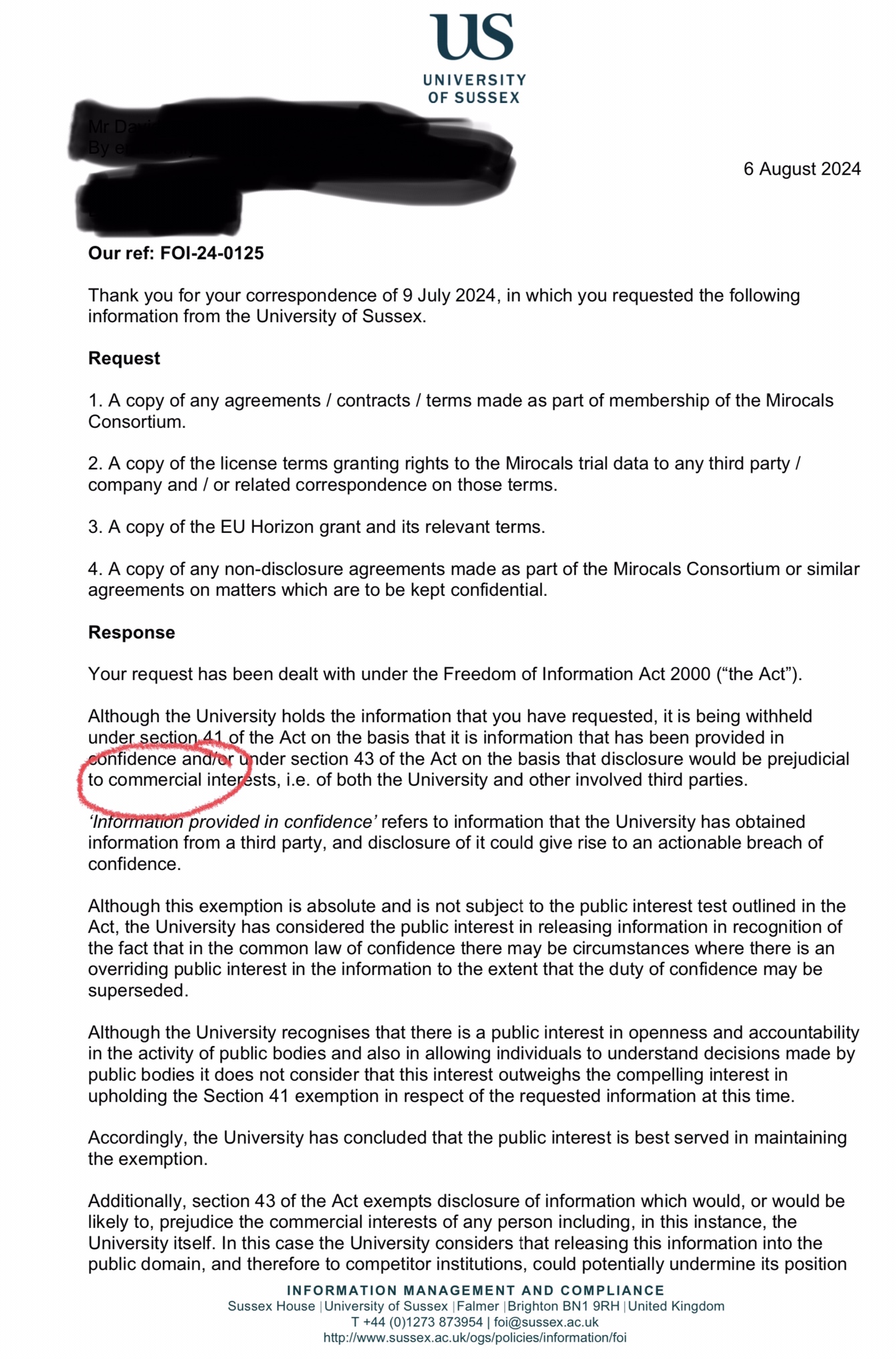
The unwillingness to disclose contractual details for a PUBLICLY and CHARITY funded trial clearly shows commercial concerns outweigh the best interests of patients.
Our full response
MNDA lists 3 potential trial outcomes. There is (at least) a vital 4th option that has been the continued focus of our posts and campaigning for the past 18 months. Given our brutal prognosis and unmet need, this specific outcome should be at the forefront of its approach. It is outcome 2 below.
1. The trial results indicate a failure. No further action is required.
2. The trial results/peer review paper are supportive of BOTH a regulatory submission AND the prescription off-label via NHS Specials or NHS Drug repurposing of the existing form of IL2 (whilst full regulatory approval is pursued) facilitated by a CONSENSUS of the UK’s leading MND Neurologists.
3. The trial results/peer review paper are supportive of a regulatory submission BUT there is NO CONSENSUS of UK leading Neurologists for its current prescription.
4. The trial results/peer review paper are not sufficient for submission but the data is promising and another trial is required.
We ask MNDA to accept that, while full regulation is obviously important, rapid ACCESS to the trial drug on publication of positive results (which we accept may not be the case) is vital for patients living with a disease without meaningful treatments.
Let’s now return to OUR QUESTIONS
We believe they are fair for a publicly and charity funded trial, using OUR money.
1. Why did it endorse the choice of a small pharmaceutical company, when a far larger company, already having the global rights to market the trial drug, low-dose Proleukin (the actual drug used in the Mirocals trial), already existed?
2. Will it, now it has finally decided to ask the questions we have been asking it to find the answers to for over a year, admit it has made an error on the commercial arrangements? If it doesn’t believe it has, we would welcome an explanation.
3. Why does it continue to highlight the new “bio-similar” version of low dose Interleukin-2 to the complete exclusion of the trial drug, Proleukin, readily available on NHS pharmacy shelves? MNDA does not appear to support access to this drug. Why?
4. Why does it continue to push for the FULLY regulated access route, rather than routes that could be explored in the interim even though they may prove difficult to navigate i.e. NHS Specials and NHS Medicines Repurposing?
5. Why does it continue to hide behind confidentiality and NDAs when it is a publicly and charity funded trial?
6. Why will it and the other members of the Mirocals Consortium not approach the current worldwide rights holder to Proleukin, Iovance, as we have suggested? We can introduce you if needed?
Our pleas to the MNDA and the Mirocals Consortium
As industry experts, we call on you once more to answer our questions, but above all, to sanction immediate release of the results, so if positive, we can work with neurologists on the fastest possible routes to access low-dose Interleukin 2 in whichever format.
If it becomes clear that a further trial is needed, there will be justifiable anger in the MND community especially if this were associated with ILT-101. This was not the drug used in the scientifically robust Mirocals trial.
There is still time for our leading charity to display the tenacity patients deserve, in trying to turn around this sorry state of affairs.

 We are United2EndMND - Changing the conversation