

Access to Interleukin 2 rolling update page
UPDATE on access to Interleukin 2 (specifically PROLEUKIN)
This is a rolling update on the campaign to secure access to Proleukin when and if the trial data proves positive.
The TARGET organisations and what we are doing/plan to do with them
Getting access to Proleukin will require many different parties to act: MND Association and other charities, the Mirocals Consortium itself, UK’s leading neuroscientists, local neurologists, and NHS England / Department of Health.
1 – The MND Association
As a result of our pressure and that of other campaigners, MNDA has finally put pressure on the Mirocals Consortium to release the trial data and/or a preprint of the paper as quickly as possible.
We need the MNDA to continue to do all they can to get the data published – both as a funder of the trial and a member of the consortium, they have an obligation to do so.
Support from the other charities will also be important, especially in helping individuals get prescriptions as an NHS Special in all parts of the UK.
2 – The Mirocals Consortium
We have written to individuals at all 12 members of the Mirocals Consortium with the same message and questions.
Our letter seeks answers to why the data is not being released, and reminds them that the trial was funded by charitable donations and taxpayers.
The members of the Consortium are: Centre Hospitalier Universitaire de Nîmes, Brighton and Sussex Medical School, ICON plc, WGK Clinical Services, Généthon, Humanitas Research Hospital Italy, King’s College London, Goeteborgs Universitet Sweden, Queen Mary University, University of Sheffield, the MND Association.
3 – The UK’s leading MND neuroscientists.
Our leading neuroscientists will play a crucial role in giving their expert view on the results of the trial. If they are all agreed that the trial shows the treatment works, this is known as a ‘positive consensus’ – it will be crucial in getting prescription of Proleukin. We are in touch with many of our leading neuroscientists to encourage them to do so asap.
4 – Neurologists at local hospitals
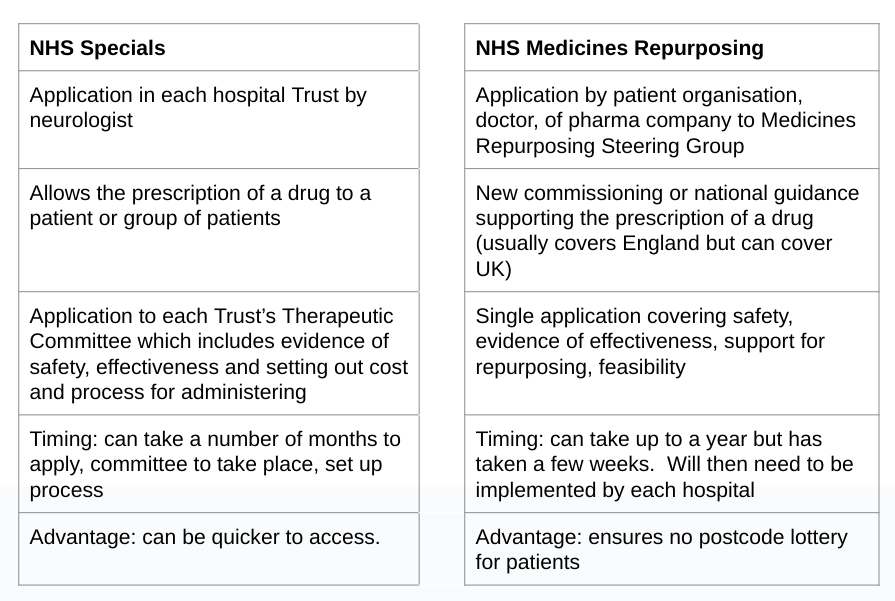
We need them to be convinced of the benefits of Proleukin and its safety and then help us get access by going for the NHS Specials/named patient route. We have been encouraging MND charities to help develop a pack of information that neurologists can use to make the case to their hospital trusts.
We know that some patients have approached their neurologists already regarding this, and, while some of the reaction may have been negative, this should change with a positive consensus emerging from the trial data. We thank you for your help in approaching your neurologists. Please keep it going!
6 – The UK Government/DHSC/NHS/other bodies
We are also planning to meet with officials at “NHS Medicines Repurposing” to investigate how quickly and efficiently that route might work, and to challenge their initial advice. We will advise as soon as possible on progress.
This is the route that the MNDA reported on its latest update. It is not the only route – individuals can seek prescription by NHS Specials.
What next?
- We must get the data!
- Leading neuroscientists need to review and come to a consensus
- Local neurologists may need support to use the NHS Specials route
- NHS Medicines Repurposing must issue new national guidance
Possible future actions.
We will be seeking media coverage through well known channels.
There will potentially be a call to action for the community e.g. probably a petition to Government. We are preparing a wording because this is extremely important to get right and at the right time. We discovered this with the petition on government funding for research a couple of years ago, when we garnered 110,000 signatures, which was exceptional.
We are also working on messages for your neurologists, local hospital trusts, MPs etc.
Finally, we will use our contacts to directly influence the appropriate Ministers.
As already mentioned, this is only likely to be effective when the data is published.
Finally we all have to be prepared for the data indicating that what we were hoping for, is not so. We need to accept this possibility, though we think it is unlikely.

 We are United2EndMND - Changing the conversation